Here’s the short answer: one snowboard bag plus one boot bag counts as a single checked bag on most major airlines, and United, Alaska and American waive the oversize fee for ski and snowboard equipment entirely. Keep the whole setup under 50 lb / 23 kg and you’ll usually pay nothing beyond the normal checked-bag fee. Pack it as if it will be dropped, because it will be — airlines explicitly refuse liability for damage to sports equipment.
Flying with a board is not complicated, but the details cost money when you get them wrong: a bag that weighs 52 lb, boots packed in the board bag that push it overweight, or a carrier that treats a snowboard as special baggage and charges accordingly. This guide covers the current US rules, how to pack so the board survives, what to carry in the boot bag, and how to choose a travel board that keeps you under the limit.
The 2026 airline rules at a glance
The pattern across US carriers is consistent: a snowboard counts as a normal checked bag, ski and snowboard bags are usually exempt from oversize fees, and the real constraint is weight. Policies change, so confirm on your airline’s site before you book — but this is where the majors stood for the 2026 season.
| Airline | Oversize fee | Weight & size limit |
|---|---|---|
| United | Waived | 50 lb / 23 kg · 115 linear in |
| Delta | Standard fees | 50 lb / 23 kg combined · 115 linear in |
| American | Waived | 50 lb · overweight fee 50–70 lb |
| Alaska | Waived | 50 lb · oversize above 115 linear in |
| Southwest | Waived | 50 lb |
- United: one set per checked bag. A boot bag containing only boots or equipment stays part of the same allowance; anything else inside counts as a separate bag.
- Delta: the combined weight of board bag and boot bag is what counts — boots in a separate bag still add to the total.
- American: one pair of skis or one snowboard plus an equipment bag counts as standard baggage.
- Alaska: a ski or snowboard bag plus a boot/helmet bag counts as one piece.
- Southwest: sporting equipment, skis included, checks as standard baggage under current rules.
International carriers are less consistent. Many European and Asian airlines treat a snowboard bag as special baggage with a flat fee each way rather than as a normal checked bag, and some require you to declare it at booking. If you’re flying outside the US, look up the specific carrier’s sports equipment page before you buy the ticket — the difference between “included” and “€60 each way” is worth ten minutes of reading.
Why weight, not size, is the real limit
The 115 linear inch (292 cm) limit sounds restrictive until you do the maths: a 165 cm board bag is typically around 168 × 33 × 18 cm, which is 219 cm — comfortably inside. Almost every snowboard bag on the market passes the size test. Weight is where bags fail.
A typical load: board 3–4 kg, a pair of bindings 1.6–2 kg, boots 2.2–3 kg, helmet 0.5 kg, shell and pants 1.5–2 kg. That’s roughly 10–12 kg before you add clothes, and a padded bag adds another 2–3 kg. You have room, but not endless room — a week’s clothing packed around the board is how a 21 kg bag becomes a 26 kg bag at the check-in counter.
Weigh the packed bag at home on a bathroom scale. It’s the single most useful five seconds of the whole trip.
Hard case, padded bag, or board sock?
| Option | Protection | Weight and cost | Best for |
|---|---|---|---|
| Hard case | Highest — resists impact and stacking | Heavy, expensive, bulky to store | Frequent flyers, expensive boards, multi-leg trips |
| Padded wheeled bag | Good, if packed well | Moderate weight, mid price | Most riders, most trips — the sensible default |
| Unpadded board bag or sock | Minimal — scratch protection only | Light and cheap | Car, train and van trips, not checked luggage |
Whatever you choose, add edge protection. A length of pipe insulation slit down the middle and pushed onto each edge costs a few dollars and prevents the board’s steel edge from cutting the bag — or the board next to it — in transit.
How to pack a snowboard bag, step by step
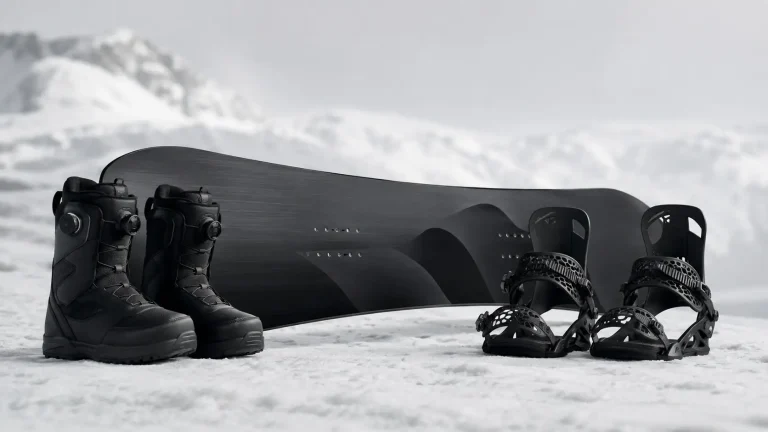
- Take the bindings off. They’re the hardest, most protruding thing in the bag. Pack them in the boot bag, or strap them to the board’s base side wrapped in a towel. Leaving them mounted creates pressure points that dent the base.
- Base down, top sheet up. The base is the part you can’t repair easily; let it face the flat side of the bag.
- Wrap the edges. Pipe insulation or a rolled towel along both edges, especially the nose and tail where the bag is thinnest.
- Boots at the ends, never on the base. Put them beside the nose or tail, not on top of the board’s middle, where they’d press into the camber.
- Use soft gear as padding. Jacket, pants and mid-layers around the nose and tail; they absorb impact and cost you no extra weight you weren’t already carrying.
- Helmet in the middle, filled. Gloves, socks and a beanie inside the helmet stop it from being crushed.
- Nothing loose and hard. Tools, water bottles and boot dryers go in the boot bag or your hold luggage — not loose against the base.
- Don’t overstuff. A bulging bag gets handled worse and the zips take the load. If it takes two people to close, remove something.
- Label it inside and out. Name, phone number and destination address inside the bag as well as on the handle tag. Add a tracker if you have one.
- Weigh it. Under 50 lb / 23 kg, and ideally under 22 kg to leave margin for a different scale at the airport.

What goes where: the packing list
| Item | Pack in | Notes |
|---|---|---|
| Snowboard | Board bag | Base down, edges wrapped |
| Bindings | Boot bag or strapped to base | Removed from the board |
| Boots | Boot bag | Dry them out first; wet liners smell for the whole trip |
| Helmet and goggles | Boot bag or board bag centre | Goggles inside the helmet, lens facing up |
| Jacket, pants, mid-layers | Board bag | Padding around nose and tail |
| Gloves, socks, beanie | Inside helmet or boot bag | Small, soft, fills dead space |
| Wax, scraper, edge tool | Checked luggage | Tools are not allowed in carry-on |
| Base cleaner, solvents | Leave at home | Flammable liquids are restricted in checked and banned in carry-on |
Choosing a board you don’t mind flying with
Two practical points for travel. First, a 155–158 cm all-mountain board is the easiest size to fly: it fits every standard bag, keeps the packed weight down, and rides everything from groomers to a foot of fresh. Second, travel boards take abuse — airline handling, rental car roofs, gondola queues — so a board you can replace without wincing is a real advantage.
The ASPECT 26A04 All-Mountain Twin — $339.99 comes in 13 lengths from 80 to 165W, so you can pick a 155 for travel and the same model in another size for home conditions. If the trip is a powder mission, the 26A05 Swallowtail (146–162, $529.99) is the dedicated deep-snow option — pack it in a 165 cm bag and it’s still inside the size limit.
For a short trip, renting at the destination can cost less than a checked bag both ways. For anything longer than a week, bringing your own board wins on both money and familiarity. Shipping ahead is a third option, but it usually costs more than a checked bag on a round trip unless you’re staying a month.
At the airport, and on arrival
- Check in early. Oversized baggage usually needs a separate drop-off, and that queue moves slowly on powder days.
- Ask for the bag to be tagged as ski/snowboard equipment. That’s how the oversize waiver gets applied.
- Keep tools and wax out of carry-on. A scraper with a sharp edge and any kind of multi-tool will be confiscated at security.
- Dry your boots before the return flight. A wet liner at 20 kg is a miserable first run on the next trip.
- Check the bag on arrival before leaving the airport. Damage claims are far easier at the baggage desk than by email a week later.
- Wax and tune before you ride. A board that’s been in a cold hold and handled roughly benefits from a fresh wax — our maintenance guide covers the ten-minute version.
Where to take it
If the flight is the hard part, the destination should be worth it. Our guide to the best snowboard destinations covers five trips worth the bag fee, from Hokkaido’s dry storms to alpine glaciers — and the travel guides section collects the rest.
Frequently Asked Questions
Do airlines charge extra for a snowboard?
On most US majors, no oversize fee — United, Alaska and American waive it for ski and snowboard equipment, and Southwest treats it as standard sporting equipment. You still pay the normal checked-bag fee for that bag, and overweight fees apply above 50 lb / 23 kg.
Can I bring a snowboard as a carry-on?
No. Boards and board bags exceed carry-on size limits on every airline. They must be checked, and they should be in a padded bag or hard case.
How much does it cost to fly with a snowboard?
Usually the price of one checked bag — roughly $35–45 on a US domestic first bag in 2026 — if you stay under the weight limit. International carriers often charge a flat special-baggage fee instead, so check before booking.
Should I take my bindings off in the board bag?
Yes. Bindings are the hardest, most protruding part of the setup and create pressure points against the base. Remove them and pack them in the boot bag, or strap them base-side wrapped in a towel.
Can I put clothes in my snowboard bag?
Yes, and you should — soft clothing is free padding. Just watch the weight: a week of clothes around a board, bindings and boots is how a bag ends up 3 kg over the limit. Note that some airlines require ski bags to contain only equipment.
What’s the maximum weight for a snowboard bag?
50 lb / 23 kg is the standard limit across US carriers. Above that you pay overweight fees, which climb steeply. Weigh the packed bag at home and aim for 22 kg to leave room for scale differences.
Pack it once, properly
One padded bag, bindings off, edges wrapped, boots at the ends, under 23 kg. That’s the whole method — and it means the only thing you think about at the airport is the snow report. Still choosing the board that goes in the bag? Start with the buying guide and confirm the length with the size guide.
Discover more from ASPECT Snowboards
Subscribe to get the latest posts sent to your email.